A live conversation with writer Joon Oluchi Lee and jeweler Tracy Steepy on how creative people uniquely define health and why it matters. For Lee, health is the luxury of forgetting the body entirely; for Steepy, it’s the rare feeling of being fully present and generative. Both have learned that creativity cannot be forced through discipline alone—it requires a body willing to meet you there.
A live conversation with writer Joon Oluchi Lee and jeweler Tracy Steepy on how creative people uniquely define health and why it matters. For Lee, health is the luxury of forgetting the body entirely; for Steepy, it’s the rare feeling of being fully present and generative. Both have learned that creativity cannot be forced through discipline alone—it requires a body willing to meet you there. We explore what gets sacrificed in a world designed for extraction, and how to protect a creative practice in spaces that compress it. This dialogue reveals how homeopathy, rooted in listening deeply to the individual story, can help restore the conditions for making by helping you become yourself again.
Roddy Schrock: This is a live recording as part of the launch of my new homeopathic service called Ultradilute. Today we’re having a group conversation about creativity and health with Tracy Steepy and Joon Lee. In full disclosure, Joon is my partner, so thank you for letting me rope you into this.
Press enter or click to view image in full size
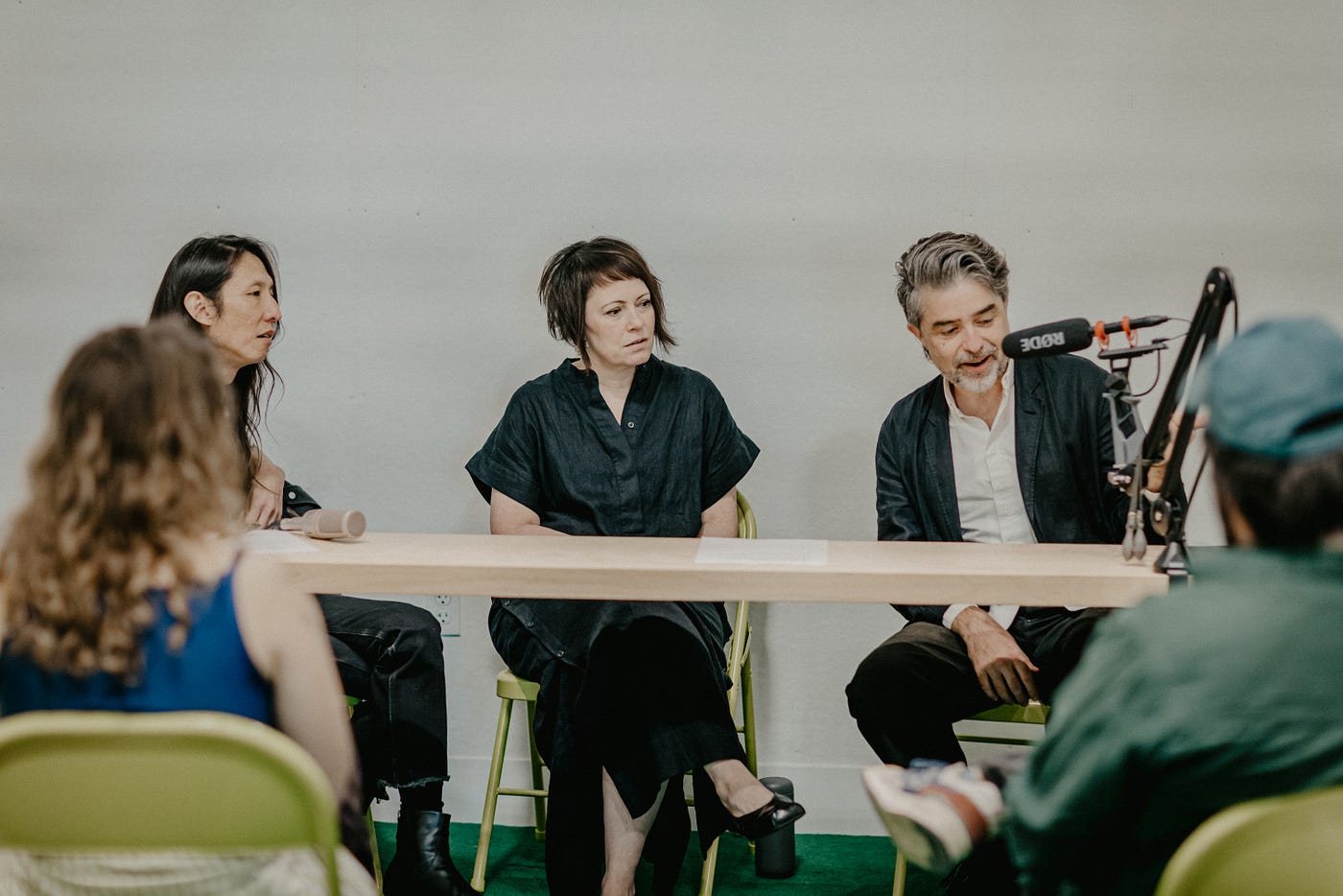
l to r: Joon Lee, Tracy Steepy, and Roddy Schrock
I think it’s amazing to have the two of you speaking, because you’re two of the most creative people I know. You’re always making things, and I get to see the process in real time, living with Joon. The question that’s been really guiding my entry into homeopathy is the relationship between what it means to build something from your imagination and how that corresponds to your sense of physical and mental health. Do they feed one another? Do they depend on one another? Where is the best way to maintain an ability to be creative when you’re also managing your health?
This conversation arose out of this observation that in many ways, the act of creativity is something that happens through health — you are creative when you are healthy. And one could say that you are healthy when you are creative. That symbiosis is very interesting.
Joon is a writer and is in the literature department at RISD. Tracy Steepy is a jeweler and head of the jewelry and metalsmithing department at RISD. So I’m turning it over to Joon to moderate.
Joon Lee: Tracy and I have been coworkers and good friends for a long time. We’ve spent a lot of time talking about our respective creative processes, when we’re doing projects and trying to get things done or cook up ideas. But we’ve never talked about it in this context — in the context of health or wellness. So this is quite new and interesting.
My first question is: How would you define health? What does health mean to you? What does that look like or feel like?
Tracy Steepy: I should preamble by saying I’ve been working with Roddy, and I’m new to exploring homeopathic remedies. So I’m kind of on the edge of taking that into the fold of how I think about some of the larger spaces of the conversation today.
Press enter or click to view image in full size
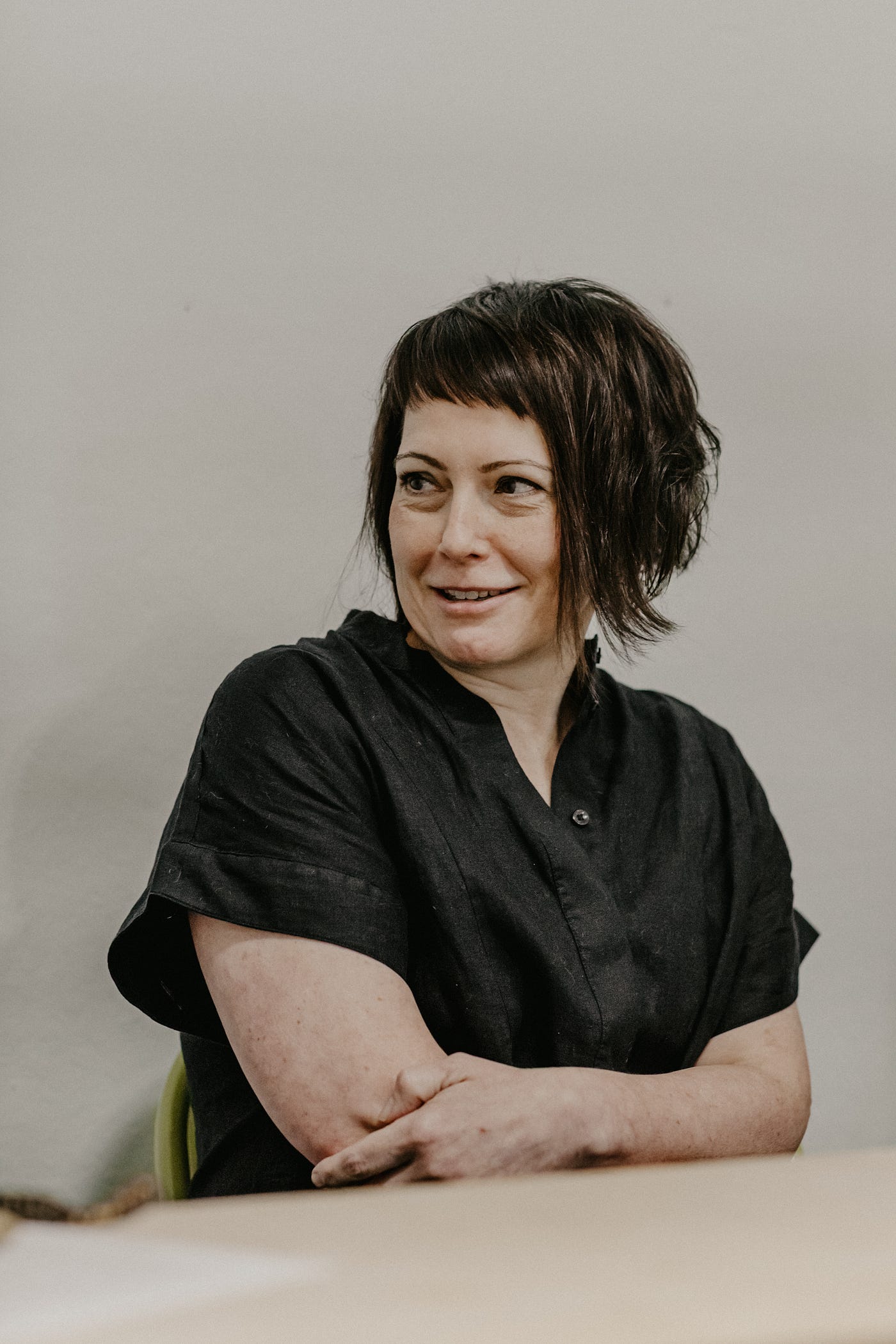
Tracy Steepy, Head of Jewelry and Metalsmithing, RISD
When you pose that question, I think we live in a society that has so much consciousness around health, but it’s dramatically counterbalanced by the modern condition, which is really pushing people. You have to be really proactive to keep your head above what it even means to be healthy. You really have to be intentional about putting energy towards it. Otherwise, for me, it’s a little bit like whack-a-mole. I can’t have everything in balance, and I don’t strive for that because I think you’re going to fail.
For me, I have to go after certain things, and when those things are in place, then I can go after other things.
Joon: What are those things that are in place? You’re saying we’re so ingrained in our culture to almost overthink about whether we’re really well or really healthy. You’re almost constantly comparing yourself to some ideal or external idea of “if you’re healthy, you should be X, Y, and Z.” Do you feel like you’re subscribing to those, or do you have your own metrics?
Tracy: I would describe it as artificial. But also, if you just think about it through our jobs — I’ve been at RISD for like 20 years. What it was back in the day versus what you take home at the end of the day is dramatically different. In my role, I’m taking care of a lot of people — faculty and students. You have to be in a place where you’re balanced enough to be in service. Otherwise, you’re not really showing up for the gig in a way that makes space for other people to meet you in the middle.
For me, it’s about how I’m protective of my time, how I have good boundaries, how I don’t spend my energy doing things I’m absolutely not interested in. It’s different when you’re older too. I have to meal prep, there’s so much stuff I have to do to be a decent person that can show up in those capacities. When you’re tapped out, you can feel it. I don’t do autopilot well — I can do autopilot, but you don’t feel good about it.
Press enter or click to view image in full size
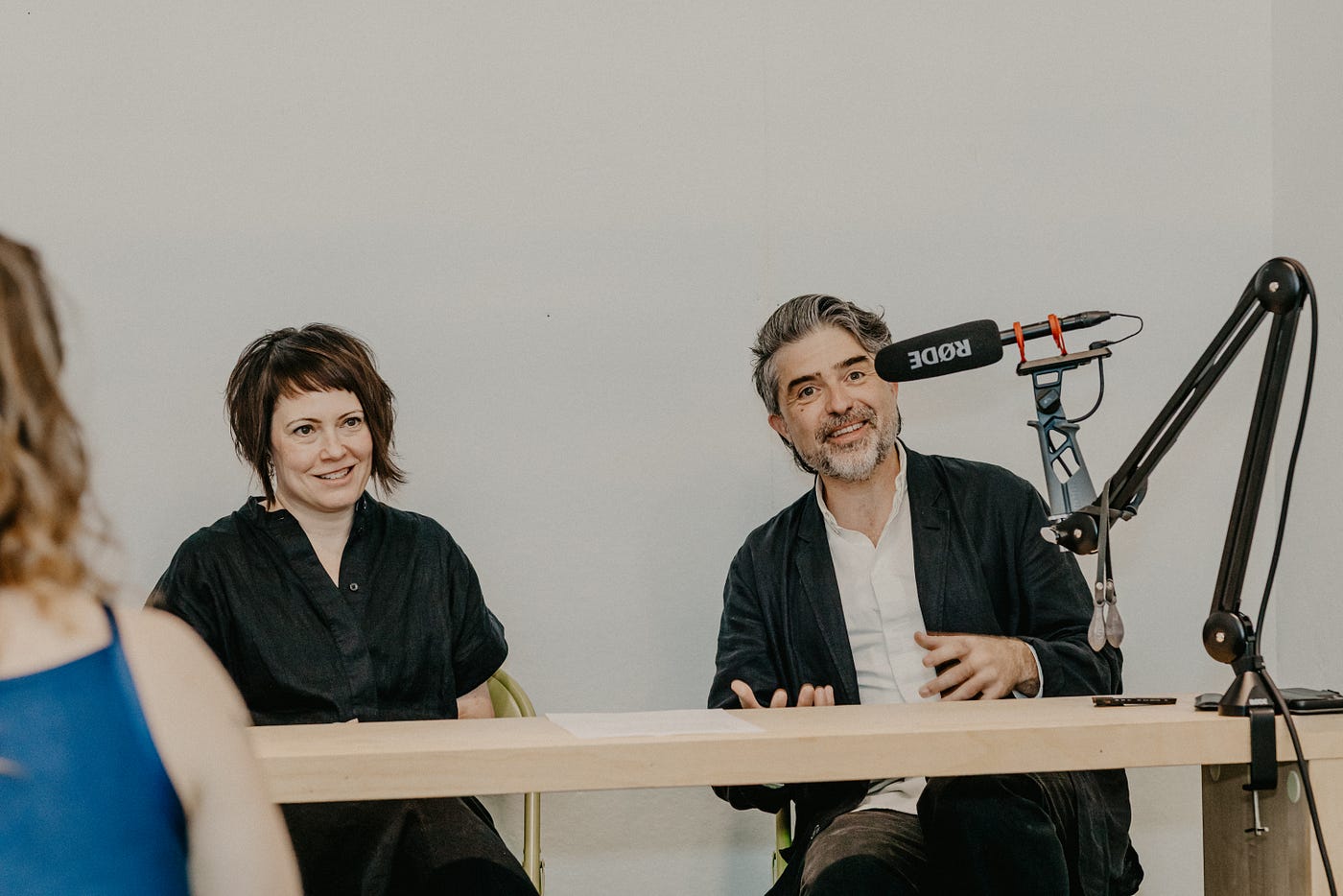
Tracy Steepy and Roddy Schrock
On the good days, you have a balance of moving and exercise and eating well. For me, it changes, and I like it to change because I like to try on different ways of trying to be in better well-being and just see if it works. That’s also like the homeopathy — it’s difficult for me to measure how it’s working, but I think it is doing something beneficial.
Joon: Do you feel like health is when you have energy to do the things that you need or want to do? How do you feel it in your body? When do you feel “Oh, I feel healthy”? What’s the indicator?
Roddy asked me this question when he started doing this work. I had to think about it because I never really think “when am I healthy?” For me, it’s when I can forget about my body — when I can forget that I almost have a body. I mean, that’s not even like spiritual stuff. It’s literally like I’m just writing and I forget that I have to go to the bathroom or eat, or I have a headache or my asthma or whatever. I’m just doing stuff and I can totally forget about my body. I don’t have to think about it. To me, that’s healthy. How do you feel it?
Tracy: It’s interesting because I’m on sabbatical right now. My two touchstones of comparison are probably somewhere between what I do in my professional life and now when you’re on sabbatical, you can be spending a tremendous amount of time alone.
I don’t want to say “you feel present” because that sounds really generic, but it’s when I don’t feel like I’m elsewhere. Part of how I came to homeopathy is dealing with menopause, and that’s been really new for me. One of the things that really happened is a kind of brain chatter that I never had before. That’s been really difficult, and now it’s getting better. It’s not happening in the same way.
For me, what I do feels really collaborative. On the good days, I love that — it feels super generative. It’s a kind of showing up. If I can’t really be there in a way that I feel like I’m part of something or I’m moving something around the room, it’s not generative. Then it just taps you out. I never really think I can be balanced, but when I’m in a space that’s feeling really generative, that feels really good. That feels really healthy. It’s bigger than you — it’s how you’re showing up to things.
Joon: What relationship would you say being well or being healthy in your body has with creativity? How are those two things related for you?
Tracy: I think you have to be in a good space. If you’re really struggling and having a hard time, it’s hard to be ambitious. If you’re struggling with depression or having mood swings or whatever can be difficult for anybody, I think it’s hard to show up in a generative way.
I think you can show up, and maybe it’s different for you as a writer — how different formats might lend to different things. But if I’m working with people and building something, that’s one thing. But when you’re spending time alone — I’m a jeweler by training, so it’s a really solitary thing — you’ve got to be kind of good with being with yourself, in whatever headspace you’re in.
Joon: Because some people would say — and I sometimes feel this way, and when I hear other people say this it sounds kind of corny, but it’s kind of true — “I only feel healthy or well when I’m being creative.” Do you feel that?
Tracy: I don’t. I can hear you say that and I don’t think it’s corny. But there is that construct of the tortured artist. There’s also people that are like “Oh my god, you get to be an artist.” And you’re like, yeah, but there’s no unicorns and fairies in my studio. You still show up. You have to make things. Is this any good? You’re self-critical. You’re hard on yourself. It’s difficult. It can be really difficult to be buoyant and have some buoyancy in those spaces if you’re not kind of okay.
I think you can make good work when you’re suffering and depressed, don’t get me wrong. But I also think being self-critical and all of that is really hard if you’re already not being kind to yourself. Everybody needs a little studio cheerleader to pop up, and if you’ve got to be that for yourself…
Joon: Yeah, you have to be. I think the corny thing becomes when it’s like “my practice is everything, nothing else matters. So if that’s good, then who cares?” I don’t feel that way because I’m not corny, but also because it’s the forgetting thing for me. When I’m writing something and it’s really going, I’m really on a roll, then I forget to eat or something. I just don’t notice if I’m sick or have a cold. If I’m really on a roll, I don’t really notice it or it doesn’t really matter. Sometimes when the creativity is really good, it can kind of overcome the physical for me. I don’t know if that’s like that for everybody.
Tracy: What you’re saying about practice — for me, that takes it out of this idea about whether it’s corny or not corny. A practice isn’t romantic. In terms of being an academic, it’s very weird to be very busy, and then all of a sudden you have this window and they’re like “yeah, okay, now be creative.” It just doesn’t really work like that.
This idea of practice — practice is a verb. You continue to show up. You’re going to have days that you feel like you don’t want to, that maybe you’re not in a good space. But that’s what discipline is. Having a practice does schedule the unicorns and the fairies. It’s not romantic. It’s the things you do.
Joon: I agree. It’s totally not romantic and it shouldn’t be. Thinking about discipline, especially in an academic context — your institution or whoever says “do all this stuff, be a teacher, be a scholar,” and then they say “go be creative.” I feel like the world in general doesn’t really support creativity or creativity as a necessity or instinct. I don’t mean just moneywise or monetarily, but it doesn’t support that as a way of being, not just a way of making money but a way of being.
To be creative, you need room and space to just imagine and wander mentally or physically. Our world doesn’t really support that, I feel. I wonder if you agree, and if you do, how you manage to find resources — internal or otherwise — to get the creative juices flowing or have a creative life, have creativity be a central part of your life?
Tracy: I’m on sabbatical, so right now it does support it. That’s such a gift, to even have that as a thing that exists. But also, you have to find it or exercise it in your space. Work is work. At the end of the day, there’s demands that come with whatever that responsibility is.
But I couldn’t be at RISD in the way that I am without feeling like, in and of itself, it has to be a creative endeavor. I think about being the head of the program creatively. It’s my tendency to want to lead, so that helps. But it’s so collaborative because you’re working with faculty and students. On the good days, you can’t take for granted — on the good days you’re showing up with someone to help them with their practice, help them follow the thread that they don’t even know might be the strength of their work. When there’s that kind of trust and you’re doing it, it’s amazing. You can see when people turn the corner with their work — it’s amazing. So you’ve got to hold on to that.
But unfortunately, you know what’s behind the curtain of the job. It’s to not let the students, or hopefully too much of your colleagues, understand what’s behind the curtain. But I think that’s part of your job. I find it really creative, but you have to build it in a way that leans into that. I think the modern condition is designed to, in some ways, go against that. I really do, and I think it’s a really hard time right now for a lot of people to feel like they’re in a space that’s very open and accessible but also isolating.
Joon: It’s like when people misuse or misappropriate capitalism as an idea. Then it’s like your ability to just sit around and write a poem — I said it like “you just sit around and write a poem” or you sit around and draw something — it’s not essential, not contributing towards the flow of life. It’s just leisure activity or something.
Press enter or click to view image in full size

Joon Lee and Tracy Steepy
That’s what I mean by it doesn’t support it. If your work is to just sit around and write a poem, they’re like “why are you sitting around and writing a poem when there’s people laboring?” The ways in which creativity is often aligned to extraneous activity or luxury or fluff. But I think what you were saying, siphoning that into other aspects of one’s life — leading the department, collaborating with your students, thinking about that as a generative or creative realm — that’s right, and that’s good. I wish I could do that more.
Tracy: But there has to be permission to leave and then bring something back with you. I’m very involved in spaces, like physical spaces. I’m having a hard time not turning things into apartments — I’m running out of spaces to flip. I can’t really do it anymore because I don’t have any more garages or whatever. But it’s like, I should be making jewelry in some way. That’s the brain chatter, because that’s my practice. But I’m not — I’m doing other things.
I’m not going to beat myself up about it. It’s ways in which I’m still exercising, I’m still building, I’m in it in the same way. I don’t know, it’s transferable and it moves around the room. But then I want to do things like what Ben is doing — could it be an artist residency? Could artists stay here? Could it merge with RISD? Again, you have to be involved in what you’re involved in that feeds you. That can be really self-satisfying, but when it goes out and can be connective tissue in other spaces or with other people or in the community, that’s where I enjoy it.
But if it is just a poem to write the poem, you still have to be doing that, to get it out, to have it be something that is greater than the sum of the parts.
Joon: But it’d be like if somebody said “go do you, but just don’t be creative.” It doesn’t make any sense.
Tracy: Yeah. It doesn’t matter.
Joon: What you said about staying, paying attention to what’s feeding you — that’s important.
— — — — —
Roddy: Listening to both of you talk, I was thinking about these questions of where health fits into however you define creativity. Where are those moments where you were not able to actually be creative in your work because of a health problem? Have you experienced that?
Joon: Yeah. The big thing that happened — this was 2017, I think, so eight years ago — I just had, out of the blue, a totally bad asthma attack where I was just wheezing and couldn’t catch my breath. We actually had to go to the emergency room in the middle of the night. They gave me the respirator and then a big packet and said “take it to your general practitioner.”
That really blocked just my life, my body. It was blocking a lot of stuff and it was hard. I went to my general practitioner thinking he’ll help me figure out what this is so I don’t have these attacks anymore. But he just prescribed an inhaler. That was it. I kept puffing it, and I was using it so much I went back to him and said “I’m using this four times a week.” He said “oh, you shouldn’t be using it that much.” I was like, well, you didn’t tell me. So he put me on a different inhaler, but without asking or figuring out what was causing it, or the thought that there might be something we could do to remove the symptom altogether so I could live seamlessly, so I didn’t have to think about my body all the time — that didn’t happen.
That’s when I saw the first homeopath. That was the first time I had even been exposed to homeopathy.
Roddy: That’s actually when I started studying. But I think what’s different in your story is that if you go to the doctor, they’re just going to give you an inhaler. What attracted me to homeopathy was this idea that there would be a way to treat the symptoms but would also actually try to remove the cause of the symptoms over time.
I think it’s different if you’re a painter and you can’t paint and you go to the doctor — “just take this inhaler.” But I think if you went to a homeopath, they would actually want to know what it is that’s blocking you from being able to paint. There would be a real concern about that as part of the whole process.
Joon: Don’t hold me up… I mean, I was a little bit skeptical at first, and I still am a little bit. Skeptical is too hard a word. But what I realized was during the time when I went to the homeopath and then a couple years afterwards, during COVID and everything, I realized when I went to the doctor and talked to him, a lot of it was just prescription. I mean, he wasn’t a pharmacist, he was a doctor of internal medicine, but a lot of it was just “here’s a prescription for whatever.”
I realized, oh wow, a lot of it is just about medicine and Big Pharma. And then I thought the homeopathy was like, when you explained it to me, I was like “this is — I don’t know what that means or I don’t know how it works exactly.” But then I thought, I don’t really know how the inhaler is working either, or I don’t know how the doctor is coming up with these decisions either. Not that I need to know exact chemistry-wise or whatever, but I was taking a leap of faith with the doctor, the normal doctor. I’m always taking a leap of faith.
So it was the same kind of leap of faith I was taking with homeopathy, where I was like, well, I don’t know exactly how it’s working, but if it’s making my body better, if it’s flattening the symptom without medicine or without chemical interference, then that’s good for me.
Roddy: I mean, that’s one of the reasons I’m really excited to think about homeopathy from the standpoint of its role in human creativity — because I think it actually is able to address a lot of the challenges that people who think creatively face, and that’s everything from jewelry to writing.
Joon: Can I ask you — this is specifically about homeopathy — if Tracy went to you and was like, “I can’t, I have to make this necklace, but I can’t bring myself to do it. I’m totally blocked. I can’t do it.” That was her symptom. Would you be able to help her?
Press enter or click to view image in full size

Joon Lee
Roddy: I think that’s what I find so valuable in homeopathy. I’m biased, especially at this point, but in that situation, you would really want to find out — what is the process of making? What does that mean? Homeopathy starts with an intake conversation. A lot of that conversation would be around — it wouldn’t be just about that blockage. It would be about what does that mean to you? What does it feel like? What does it feel like in your body when you can’t do it? Do you have physical sensations when you’re trying to make jewelry?
It would really be built around trying to understand what that sensation feels like in the body and in the mind, and then hopefully that would open up, ideally, a larger picture of what the totality of the issue is.
Tracy: Having done that conversation, you’re asking very direct questions, but they’re very nuanced. What you’re asking is very nuanced. At the end of it, when you ask “what are the three measures that you want to return to and map” — that was really helpful for me, because that was my measure. It wasn’t your measure, or it wasn’t something you were saying like “this is what you’ve got to watch.” It was like, for me, what do I want to pay attention to after having done this? That felt really good because that’s coming through my filter, and it’s coming through what I’m trying to push against.
I would also just say you should have another podcast about homeopathic remedies and dreaming, because that’s the biggest measure of what I could — I was like, oh, it’s totally changing my dreams, and it’s changing my sleep. I know I was struggling with sleep again because that was one of the symptoms I was dealing with with menopause, but it really changed my dreams dramatically. And that was interesting. That was the one thing I was like, okay, I can’t attribute this to anything else. It’s not my diet, it’s not my exercise. I’ve been living in my body for some time now, and then that was the one thing. I was like, wow, that’s very interesting. So I knew I was doing something subconsciously.
Roddy: That’s another beautiful thing about homeopathy, I think — it actually sees the mind and the body as being so deeply intertwined. Not necessarily even from a spiritual perspective, but just literally, these two things have a deep impact on one another. Usually when one starts getting unblocked, then the other will start moving as well. That’s not uncommon, actually, what you’re describing.
Tracy: It was good to hear that too, because I was like, I’ve got to talk to Roddy — something’s going on. I don’t find that much different than if you have ever had a meditation practice. Someone can say, “well, how can you measure it’s doing anything?” You’re like, well, you just can. You can’t prove it in some ways to be true, but you can have the markers. And you can say all these markers are changing.
Roddy: And we have a small audience here. I don’t know if there are any thoughts, questions, feedback, or further advice that anyone would like to offer?
— — — — —
Audience Questions
Audience Member 1: I was kind of curious because I don’t know a ton about homeopathy, but what was the regimen like when you were working with Tracy? It’s interesting because when it’s not specified, it kind of sounds like therapy, like talk therapy. But I’m curious — was there something that you were taking that was changing your dreams?
Tracy: Well, first of all, I haven’t done any other kind of medication trying to deal with some issues I was having. I had a partner whose sister studied homeopathic medicine, so my partner was always doing remedies and I was always around that. So I was very comfortable with that already. I think that was a good precursor for me.
When I found out Roddy was training to practice, that was a collision point for me. I had had a really hard winter with menopause. Menopause was — and I mean I’m not out of it — but it was really hard on me in ways that perimenopause was even harder. I had a partner then, so it’s like you kind of feel like you’re going crazy in some ways, or at least I did. I really wasn’t myself, and that’s okay.
I was talking to Roddy and found out he was training. We met, we had the intake, and in some ways — I’ve done my fair share of therapies — I would say the intake was very… I mean, it was good that I feel comfortable with you, because I think it was a very vulnerable situation or conversation. It went pretty deep, but it felt like it was good for you to hear some of those things.
I don’t know what the cocktail is that he’s mixing, but he says “you get this, and this is how you take it.” And I say okay, and I do it, and then I’m just trying to pay attention to paying attention and see if certain things are changing. For me, the dream space was the biggest kind of punctuation.
Roddy: I’m not mixing the cocktail. Essentially what we do is try to get a sense through all the details that the client provides — what is this total picture of their mental state, their physical problems — and then really treating them with equal care. Sometimes the physical elements are just front and center and that becomes very clear. Other times the mental or emotional components can round that out.
At the end of that, I essentially have a picture, a map written in terms of what this looks like. The idea is that there’s an element in nature, an element in the world that matches that specific picture for that individual. Then you cross-check that through literature and make sure this actually adds up.
At that point, I would just send an email to Tracy and say “here’s what I’m recommending,” and then she can order it from an FDA-regulated pharmacy so the production process is fully monitored. There’s a certain way that you take it over time, and then we just track those symptoms. Ideally, you start to see progress in a few months. You shift things as you need to, and it’s an ongoing process. I would like to think that I could ideally get to the point where that wouldn’t be necessary with a client — at some point it would be great if we didn’t have to work together anymore.
Tracy: But it’s not like your leg’s bothering you and Roddy’s like “how’s your leg doing?” It’s more like, you know, because he said “what do you want the things for me to check back in on?” For me, one of those was productivity, because I would be having a hard time just with the loop, or being hard on myself. I just couldn’t — I get a lot of stuff done, I’m very productive, but I was just feeling so tapped, so tapped out. I couldn’t self-generate it. I was just burnt out.
I feel like the markers, at least maybe for other people they’re different, but for me they weren’t the physical. It was more these things that I was just like “why can’t I get to this like I used to?” or “why does this feel like such a struggle?”
Roddy: I think that’s where homeopathy is really well suited to help — in those situations that don’t fall into really clear markers, where there is some blurriness in terms of how these things relate. It lends itself to that. I’m glad that it’s helping.
— — — — —
Audience Member 2: I’m curious about the role of placebo, or like using — sometimes if you just focus on the taste of a cup of tea, it can help you in different ways. I wonder sometimes with practices like this, how much is there an assumed or direct link between specific cocktail versus the cocktail being a catalyst for people to focus their mind to put their bodies in a comfortable room? In that case, it’s not a placebo — it is a catalyst. But I just don’t know a lot about the practice. I’m having trouble making a painting, here’s some dandelion — I don’t know what that aroma and setting is doing.
Roddy: That’s a really good question. First of all, there are reams of research that actually show that homeopathy performs better than placebo. The Homeopathy Research Institute in the UK has a lot of up-to-date information on some of those meta-analyses and so forth.
But I also don’t think one should underestimate the power of placebo either. I feel, for a number of reasons, that homeopathy performs better than placebo by far. In fact, when you look at the efficacy of treatment between conventional medicine and homeopathic medicine, when you compare meta-analyses over the last 11 years, you’ll find that homeopathic treatment shows a 42% positive efficacy rate, which doesn’t sound that high, but is comparable to conventional medicine, which typically shows a 45% positive efficacy rate. You’re already comparing a comparable rate of positive efficacy.
There have been recent studies that have shown that homeopathy used in plant production and in agriculture perform better. I don’t think the wheat is like “oh, I’m thinking better, I’m going to feel better.” I feel like that discounts the placebo effect in homeopathy as well. And then also for animals — there are farmers in the UK who use homeopathic treatment for their cattle, and there have been studies that show that’s helpful to them as well.
I think it’s definitely more than placebo. There’s a lot of research that shows that. But I also sometimes feel like placebo gets a bad rap too. There’s an element of that that can be positive as well. While I don’t think one should rely on it fully, to acknowledge that it has a positive force is just a rational evaluation as well.
Tracy: But it can also go both ways. I haven’t had that experience, but I know people that have taken remedies and gotten really sick, and that’s supposed to be working. I didn’t have a physically negative reaction, but that can also happen too.
Roddy: It’s medicine. There are good practitioners and some practitioners that have maybe a different approach to it. But I think with good training, you can limit the negative as much as possible — you don’t want that at all. There’s just variance in the world of homeopathy, just like there would be in every world.
— — — — —
Tanya Kell (President of the North American Society of Homeopathy): I want to not breeze past the word “catalyst,” because that’s exactly what’s happening in homeopathy.
There’s lots of controversy about what’s a homeopathic medicine, how does it work, what’s the process in the body. And it all boils down to: it’s a catalyst. You have everything you need within yourself to heal. Sometimes you lose your way or you get tired. A homeopathic remedy is not coming in and taking over as drugs would, and forcing any sort of process that is not natural and inherent to you. It’s simply a catalyst for your higher purpose, your fullest expression.
We see health in a broader context. We see the desire to help, the interconnectedness of all people as measures of health — not just the absence of a diagnosed pathology.
Roddy: We’re lucky to have Tanya here today as the president of the North American Society of Homeopathy and also a practicing homeopath. Thank you for helping fill out this question.
Tracy: It’s such an interesting moment. I mean, it’s really good to hear you say that too. I just think it’s such an interesting moment to be thinking about all of this where everything’s happening right now in the government with healthcare. I do feel like we are in a time that’s super exciting and you can feel empowered that you have other options of the ways that you can holistically try to put some things together.
Maybe it’s not how it should be, but I feel like I like to try things on, because it’s so personal what works for you and what doesn’t work for you. For me, it’s been really helpful to just try something for three months — just commit to it for three months and see if it is catalyzing something, bringing something else forward that is just good to pay attention to.
Roddy: Yeah. It’s like why not have a selection of options? And especially if you’re seeing efficacy and if you’re able to acknowledge that efficacy, why not fund it? Why not make it available? And of course, study it with a rigorous approach, but at the same time, making it available just seems like an obvious thing to do.